News · September 23, 2026 · 3 min read
What Happens If Rain.xyz (or Wirex) Shuts Down?
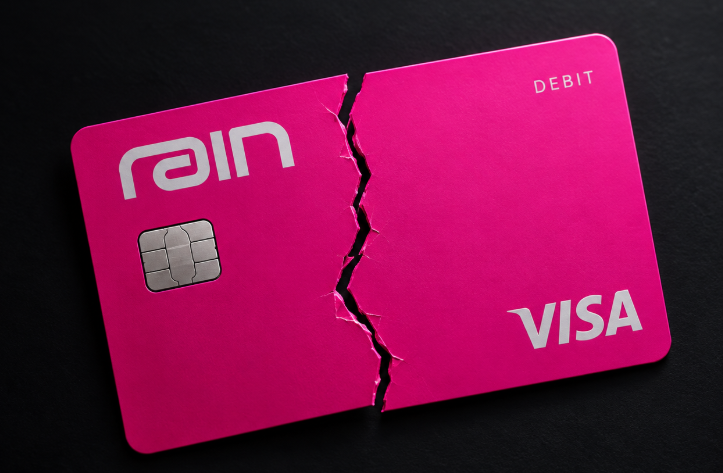
What Happens If Rain Cards (or Wirex) Shuts Down?
Rain is the largest crypto card provider right now, and it's not even close. Rain alone issues cards to over 130 "Crypto Neobanks." These are the guys selling spades during the crypto card gold mine.
But what happens when regulation changes, or something goes wrong on the back end? What happens when Rain or Wirex shuts down? Well, for users of Rain cards, it will suck. But for the stablecoin payments industry, this could be catastrophic. Of the 25 active cards showing up on Paymentscan, 18 rely entirely on Rain or Wirex.
You can argue we're building on a shaky foundation here, one that can come tumbling down pretty quickly. And it's scary because if Rain goes down tomorrow, the entire industry goes dark overnight. It will be a nightmare for both the customer and the Stablecoin Payments industry.
How it could happen:
Rain operates as a Visa Principal Member. They bypass traditional partner banks to issue cards and manage the regulatory compliance directly. If Rain fails to meet capital requirements or enters administration, Rain also maintains compliance infrastructure.
If Rain gets something major wrong in the backend, or regulation forces a switch, Visa might sever the connection.
What happens to the Customer:
1. THE KILL SWITCH. If you're lucky, VISA sends a warning; this might be weeks, this might be days. Ready Card got a two-hour warning. Every single card tied to their infrastructure declines at the terminal immediately. 130 neobanks lose their core feature in seconds. There is no backup bank to keep the lights on. There is no negotiation and no time to migrate.
Whether you paid $50 for your card or got it for free, it will no longer work, and you won't get a refund.
I run CardifyCrypto.com where I test crypto cards every day and rank them accordingly. Basically entire card deck would be wiped out.
2. API's BREAK. Across all the supporting neobanks, they start throwing 500 server errors. App dashboards freeze. Balance updates stop reflecting real-time state. Support teams have no visibility into what is happening. The API is gone.
3. TOP-DOWN FAILURE. Most believe Rain is just a card issuer; for many Neobanks, they offer the cards, the on-ramps, the off-ramps, the Virtual accounts, and the Payments. All in one point-of-entry failure.
4. CUSTODY LESSONS. This is where the product architecture either saves or destroys the users. A lot of founders are pitching "non-custodial" crypto cards that require you to top up a balance before you spend. The non-custodial top-up card is an illusion. The moment you move crypto from your wallet to a prepaid card balance, you surrender custody. If the issuer goes down, your main wallet is safe. But every dollar you topped up is trapped in a bankruptcy estate. True non-custodial cards use smart contracts to authorize a spend directly from your self-hosted wallet at the exact moment you swipe. Your money stays in your control until the point of sale.
5. THE SCRAMBLE. The surviving neobanks scramble to find a backup issuer. But setting up a new principal membership, integrating APIs, and securing BIN sponsorship takes six to eighteen months. Most consumer fintechs lack the runway to survive a year without their core product functioning.
The Industry Catastrophe
I can't see it happening, but the real issue is the lack of decentralisation in this scenario.
Beyond the immediate user chaos, a Rain collapse would destroy years of progress for the broader Stablecoin payments space.
Web3 spent half a decade convincing mainstream users that stablecoins are a legitimate alternative to traditional banking. The whole point is decentralisation, yet a single $700 million blackout erases retail trust overnight.
Regulators would get the exact headline they need to crack down on stablecoin daily settlement and non-bank BIN sponsorship.
Look, I could argue the same about VISA or MasterCard. This is a massive "IF", and were this to happen, it would more than likely be a slow wind-down, not a 2-hour window.
Rain currently issues cards for EtherFi, Kast, Plasma, Karta, Kolo, Avici, Tangem, Tria, Solid, Western Union, and many more.
Wirex currently issues cards for Wirex One, Coca, Bfinance, Ethena Pay, Send, and you get the point.
But between Rain and Wirex, it's almost 1 billion dollars in monthly volume. A single point of failure would be catastrophic and leave many scrambling for the company that completed the hard work instead of the easy Rain card integration.
When you build on a single point of failure, you rent your business.
For founders, control your own infrastructure wherever possible. For users, the golden rule remains unchanged. Treat any crypto card strictly for spending.